CINCH CYCLING
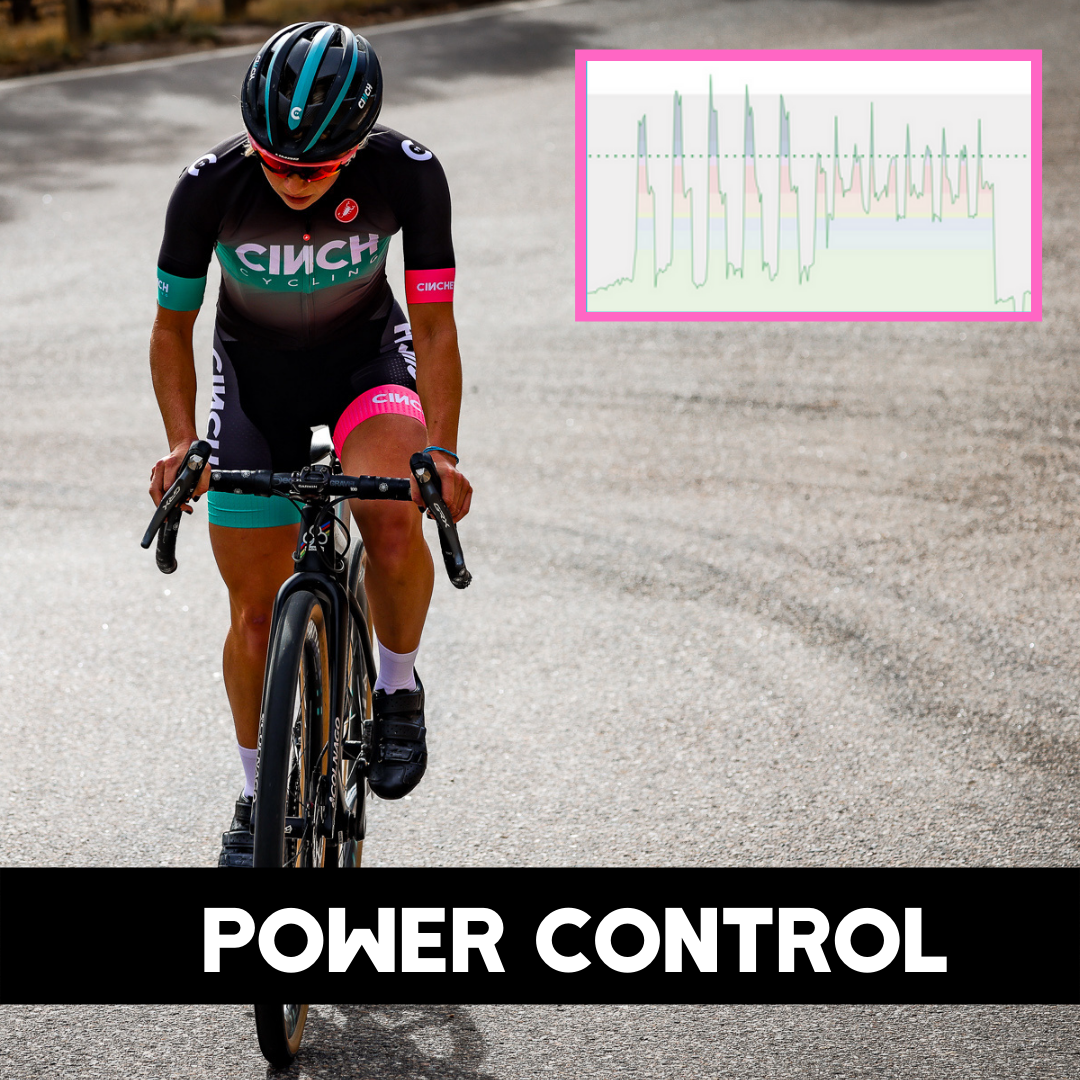
A cyclist in a black and teal CINCH Cycling kit rides toward the camera on an empty road, looking down. An inset power graph shows repeated sharp spikes above a dotted line, then a more variable section. Banner text reads "POWER CONTROL".

Training Tips · Tue Nov 30, 2021

How To Make Your Power Faster

Winning isn't about the highest watts. Learn Power Control, which uses terrain, momentum, Power Floors and Ceilings to turn your power into more speed.

Is there a way for you to go faster using less power? Yes! It is called Power Control.

In every race, there is the person who averages the most watts, hits the highest numbers, and then there is the person who wins. They are rarely the same rider. Even though our power-meter-obsessed sport has gotten to the point where it feels like the only thing that matters is normalized power or FTP, that isn’t always what wins races. Cycling is still a game like any other sport.

Take tennis, for example. The announcers might touch on the fact that Serena Williams can serve a ball at over 100 miles per hour, but that’s not the key talking point after the match. Instead, they discuss how brilliantly she placed her shots throughout the court, how she responded to her rival’s shots, how she used her powerful swing at just the right moment to hit the winning shot.

We want you to stop judging your cycling by the numbers on your power meter and start judging it based on speed. While it may be difficult to measure or quantify, speed is what wins races. Of course, the first step is training and riding enough to establish a foundation of power that you can produce as a cyclist. We’ll teach you is how to use that power in the most efficient way possible to maximize speed and momentum. That’s what Power Control is all about.

You’ll use the terrain to gain momentum when it suits the PTZ you intend to use. As things progress, you’ll find opportunities to maintain that momentum without going above or below that PTZ.

We know we just told you not to fixate on your power meter’s numbers, but we aren’t going to throw out those expensive components and devices. Instead, similar to your own power as a cyclist, we’ll use those tools carefully to chase the elusive momentum that will help you win. There are two key Power Control concepts: Power Floors and Power Ceilings.
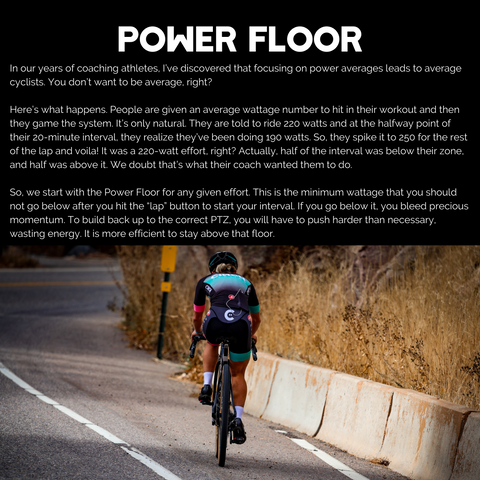
Graphic titled "Power Floor" with text explaining that riders should hold a minimum wattage during intervals instead of averaging. Below it, a cyclist seen from behind climbs a sunlit road past dry grass and a concrete barrier.
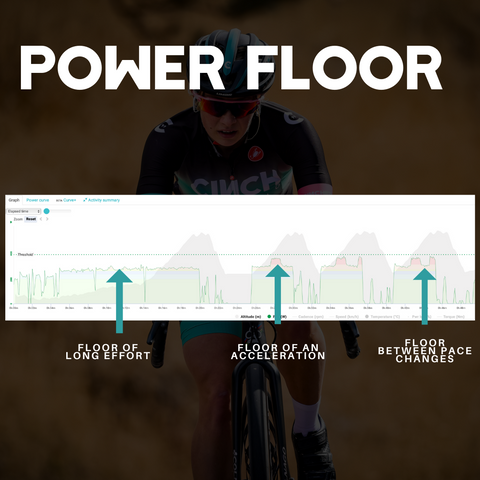
Title graphic reading "Power Floor" over a darkened photo of a cyclist in a helmet and sunglasses. A power graph overlay has three teal arrows marking floors: of a long effort, of an acceleration, and between pace changes.
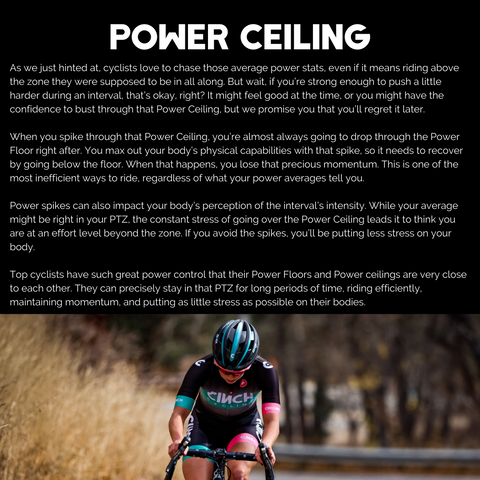
Graphic headed "Power Ceiling" with paragraphs on how spiking above the target power zone forces a drop below the Power Floor. Below the text, a cyclist in a teal helmet and black kit rides toward the camera beside dry golden grass.
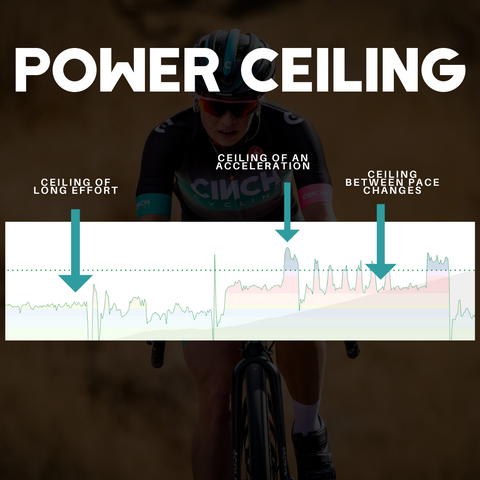
Graphic titled "Power Ceiling" over a darkened photo of a cyclist in a black Cinch kit. A power graph with a dotted line has three teal arrows marking the ceiling of a long effort, of an acceleration, and between pace changes.
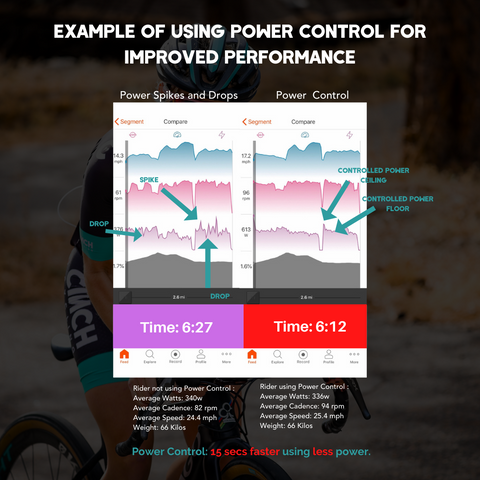
Comparison graphic of two segment power charts. Without power control, the power line shows spikes and drops and the time is 6:27 at 340w. With power control, it stays between a ceiling and floor, finishing in 6:12 at 336w, 15 seconds faster.
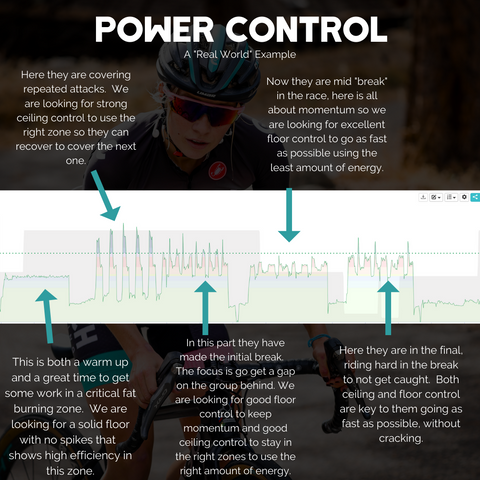
Infographic titled "Power Control: a real world example" over a photo of a helmeted, sunglassed female rider. A race power graph has teal arrows marking sections: warm-up floor, repeated attack spikes, break momentum, and final ceiling and floor control.

Next step

Ride your next hundred with a plan.

Forty-five minutes with a Cinch coach about your riding. Nothing to pay.

Book a free consult
Questions about this one?Ask Tom and other riders in Cinch Community. Sign in or join free.
Discuss this article
Written byKourtney DanielsonKourtney co-founded Cinch with Tom and created the 3-Sigma Nutrition System, which teaches busy cyclists how to fuel for peak performance.All 281 articles by Kourtney

Keep reading