In cycling right now, everyone is obsessed with carbs per hour.
90g per hour. 120g per hour. How to stack glucose-to-fructose ratios. How to squeeze one more gel in.
Before you even start to worry if you are eating enough carbs on the bike you first must nail the amount of carbs you are eating before and after your workouts.
And yes, fueling during the ride is important.
We want to keep blood glucose stable, protect muscle glycogen, and support performance.
But here’s the thing almost no one is talking about:
Your performance is determined WAY more by what and when you eat before and after the ride, not just how many carbs you take in once you're already pedaling.
That’s why at CINCH, we don’t look at fueling as just “gel math.” We look at the fuel strategy as part of your execution system, the same way we approach the details that make up the performance: the torque, cadence, mindset, nutrition, and the tactics.
Part 1 - Before the Ride: Filling up the tank
Your pre-ride fueling sets your:
- Blood glucose baseline
- Muscle glycogen availability
- Brain state
If you start the ride depleted or under-fueled, you don’t have any workout foundation. Instead you are already in survival mode.
And survival mode makes you:
- Chase your numbers
- Burn mental matches in panic
- Doubt your ability
- Struggle to be able to ride high-cadence outputs
Bottom line, you cannot execute the key cycling Plays on fumes.
Execution requires energy.
Your pre-ride carbs are not just “calories.”
They are the fuel your engine needs to run.
Part 2 - During the Ride: Padding the System
Once you're riding, carbs per hour are simply padding. What you take on during the ride should not be viewed as putting in exactly what you need to use.
The carbs you eat during the workout keep:
- Your blood glucose stable
- Your brain sharp
- Your muscles supple and energetic
- Your power delivery smooth
But if you didn’t fuel properly going in, all the carbs in the world mid-ride can’t rebuild what isn’t there.
Mid-ride fueling helps preserve performance.
It does not create it.
Part 3- After the Ride: Amplifying the Gains
This is where most riders lose the plot.
You finish a hard ride and think the work is done, but it’s just the first half. Here is a critical time to replenish the glycogen in your muscles with carbohydrates.
Your post-ride fueling impacts:
- The fuel you have to train with the following day
- How well you adapt to training effort
- The speed of your metabolism
- Your energy level and mood
- Your muscle soreness
The bottom line is that your post ride carbs are for your progress.
If you skip them you are just holding yourself back!
CINCH Carb Fueling Philosophy: Timing Creates Performance
The CINCH system teaches athletes to fuel with carbs in Three Phases:
| Purpose | Timing | Composition |
| Load Pre-Ride Fuel | 2 - 3 hours before your workout, ride, or event | About 30% of your daily carb intake should come in the pre-ride meal. A rough estimate that works for most people is try and get 1/2 of your body weight (lbs) in carbs (g). |
| Pad Storages with during Fuel | Every 45 mins to 1 hour | 30-60 grams per every 45-60 mins works well for many people. |
| Replenish Post-Ride Fuel | 30 mins to 1 hour after the workout. | Like your pre-ride meal, about 30% of your daily carb intake should come in the post-ride meal. A rough estimate that works for most people is try and get 1/2 of your body weight (lbs) in carbs (g). |
In other words, timing is everything.
Examples and Recipes of Good Pre and Post Ride Meals

Super Simple Banana Pancakes
Ingredients:
1 large ripe banana
2 large eggs
1⁄2 cup oats
1⁄4 tsp cinnamon Dash of almond milk
Instructions:
- Put the banana in a bowl and mash with a fork.
- Add the eggs and mix until well combined.
- Put the oats in a blender and blend until fine.
- Add the blended oats and cinnamon to the banana mix, and stir well.
- Heat a skillet over a medium heat with a dash of vegetable oil.
- Pour 1⁄4 cup of the mixture into the skillet, cook on one side for about 1.5 minutes, then turn and cook on the other side for about 1 minute (or until golden brown on both sides).
- Serve (with or without maple syrup) and enjoy.
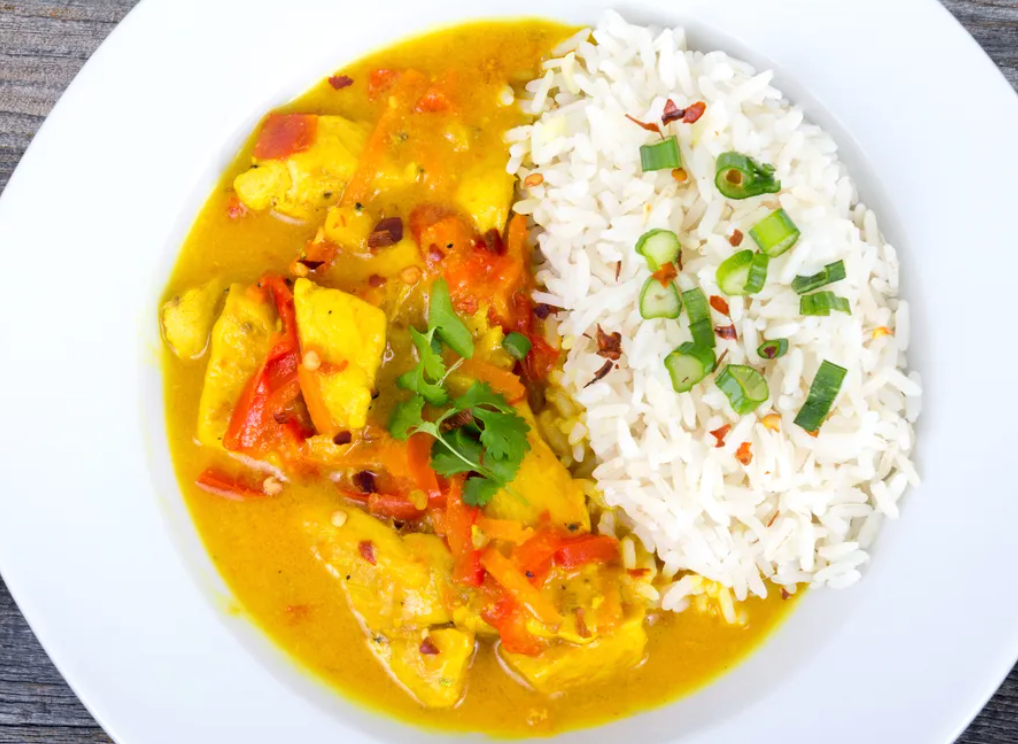
Coconut Chicken Curry in a Hurry
Ingredients:
2 pounds boneless, skinless chicken breasts or thighs (about 4 breasts or 7 thighs), cut into 1" cubes
1 cup of cooked white rice
2 1/2 teaspoons mild curry powder
1 1/2 teaspoons kosher salt
1/2 teaspoon freshly ground black pepper
2 tablespoons virgin coconut or vegetable oil (plus 2 teaspoons; optional)
1/2 medium onion, chopped
1 (14-ounce) can coconut milk (preferably full-fat)
1 (2 1/2") piece ginger, peeled
4 garlic cloves, peeled
1/4 cup raw cashews, chopped (optional)
1 1/2 teaspoons yellow and/or black mustard seeds (optional)
5 ounces baby spinach
Cilantro leaves with tender stems and cooked rice or naan (Indian flatbread; for serving)
Instructions:
1. Toss chicken with curry powder, salt, and pepper in a medium bowl.
2. Heat 2 Tbsp. oil in a large skillet (at least 12" in diameter) over medium-high. Add onion and cook, stirring, until softened, about 2 minutes.
3. Purée coconut milk, ginger, and garlic in a blender until very smooth.
4. Add chicken and coconut milk mixture to skillet and cook, tossing occasionally, until chicken is cooked through and sauce has thickened, 7-10 minutes.
5. Meanwhile, if using, heat 2 tsp. oil in a small skillet over medium. Add cashews and mustard seeds and cook, stirring, until fragrant and lightly browned, 2–3 minutes. Immediately transfer mixture including the oil to a small bowl.
6. Fold spinach into chicken mixture and cook until wilted, about 1 minute. Divide among 4 bowls.
7. Top with cilantro and cashew mixture, if using. Serve with rice or naan alongside. Tip- Make double for the week ahead. Add any seasonal veggies for an extra boost of nutrition.